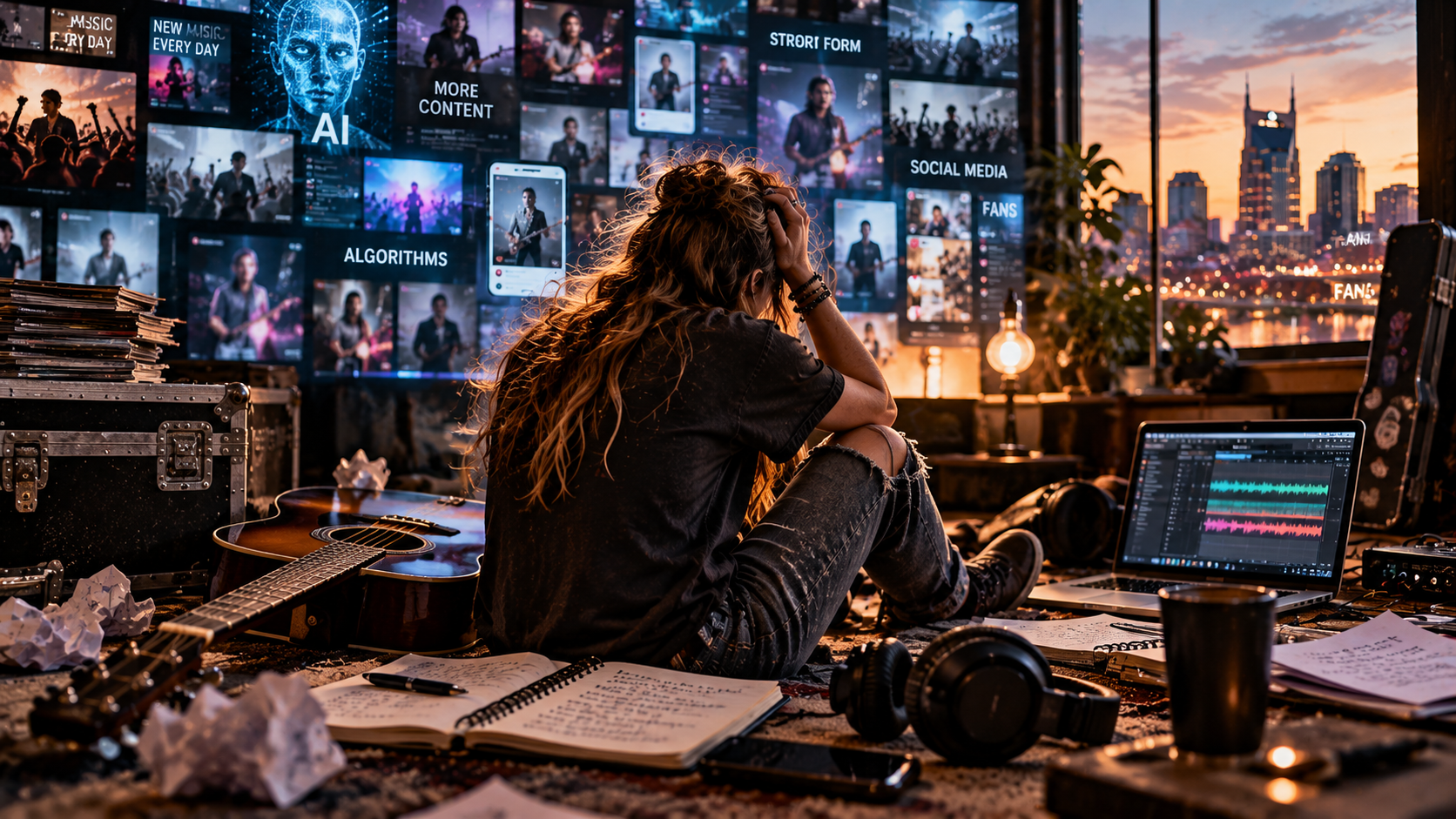
Making music has never been easier to access. Building a career around it may be getting harder.
Artists today aren't simply competing with other artists for a listener's attention. They are navigating an environment filled with an extraordinary volume of new releases, short-form content, algorithms, artificial intelligence, rising expectations from fans and the constant pressure to remain visible.
The challenge is no longer simply releasing good music.
It's getting someone to stop long enough to care about it.
More Music, Less Attention
The volume of music entering streaming platforms has become difficult to comprehend.
A recent lawsuit filed by Universal Music Group against DistroKid alleges that the distributor delivered nearly 12 million tracks to one major streaming service in only six months. The filing also raises concerns about high-volume accounts releasing thousands of tracks, including material UMG says was generated using AI.
The claims are now being litigated, but the larger issue facing artists is already clear: the amount of content competing for attention continues to grow.
For a working artist, that changes the equation.
Releasing a song is relatively easy. Getting it discovered, remembered and connected to the artist behind it is much harder.
Artists Are Competing With Technology Too
Artificial intelligence adds another layer.
Artists are increasingly asking questions that barely existed a few years ago. Who controls their voice? Their likeness? Their musical identity? Can an AI platform create something designed to sound or feel like them?
Those questions are now reaching the courts.
Artists including Jason Isbell and David Lowery filed a proposed class-action lawsuit against Suno focused not on traditional copyright claims, but on the alleged commercial use of artist identities. Meanwhile, Sony Music Group recently became the first music company to join ARIAM, a coalition focused on responsible AI across creative industries.
AI isn't simply becoming another creative tool. It is forcing the music business to reconsider what an artist's identity itself is worth.
Being Discovered Isn't the Same as Building a Career
Streaming gave artists extraordinary access to a global audience. But access to listeners and ownership of a fan relationship are very different things.
An artist can accumulate streams, followers, views and likes while knowing remarkably little about the people actually listening.
That is one reason the industry is increasingly focused on direct-to-fan relationships and superfans. Music companies and technology platforms are investing heavily in ways to help artists identify their most engaged listeners and build relationships beyond the stream.
For artists, the opportunity is important, but so is the challenge.
They are now expected to be musicians, content creators, marketers, merchandisers, community builders and small-business owners, often at the same time.
Fans Have More Choices Than Ever
There is another side to the attention problem: fans themselves are overwhelmed.
Every day brings another song, playlist, video, post, notification, tour announcement, limited edition, VIP package or exclusive experience.
Artists therefore aren't only competing for listening time. They are competing for attention, money and emotional investment.
The industry has increasingly turned toward the superfan as an answer, but even that comes with a warning. Recent research from MIDiA has questioned whether constantly creating more expensive VIP tiers and premium products risks turning fandom into something increasingly transactional.
The goal cannot simply be finding new ways to charge the same fans more.
The stronger opportunity may be giving fans more reasons to genuinely care.
The Artist Still Has Something Technology Can't Manufacture
Technology can distribute a song almost instantly. Algorithms can recommend it. AI can generate music at enormous scale. Social platforms can put an artist in front of millions of people.
None of those things automatically creates a meaningful connection.
That remains the artist's advantage.
The story behind the music, the live performance, the interaction with a fan, the signed album, the unexpected conversation after a show and the feeling of discovering an artist before everyone else are difficult to reduce to an algorithm.
As the amount of music grows, those human connections may become more valuable, not less.
The challenge facing artists today isn't simply how to reach more people.
It is figuring out how to turn attention into listeners, listeners into fans and fans into relationships that last.
In a world with more music than ever, being available everywhere may matter less than giving people a reason to remember who you are.