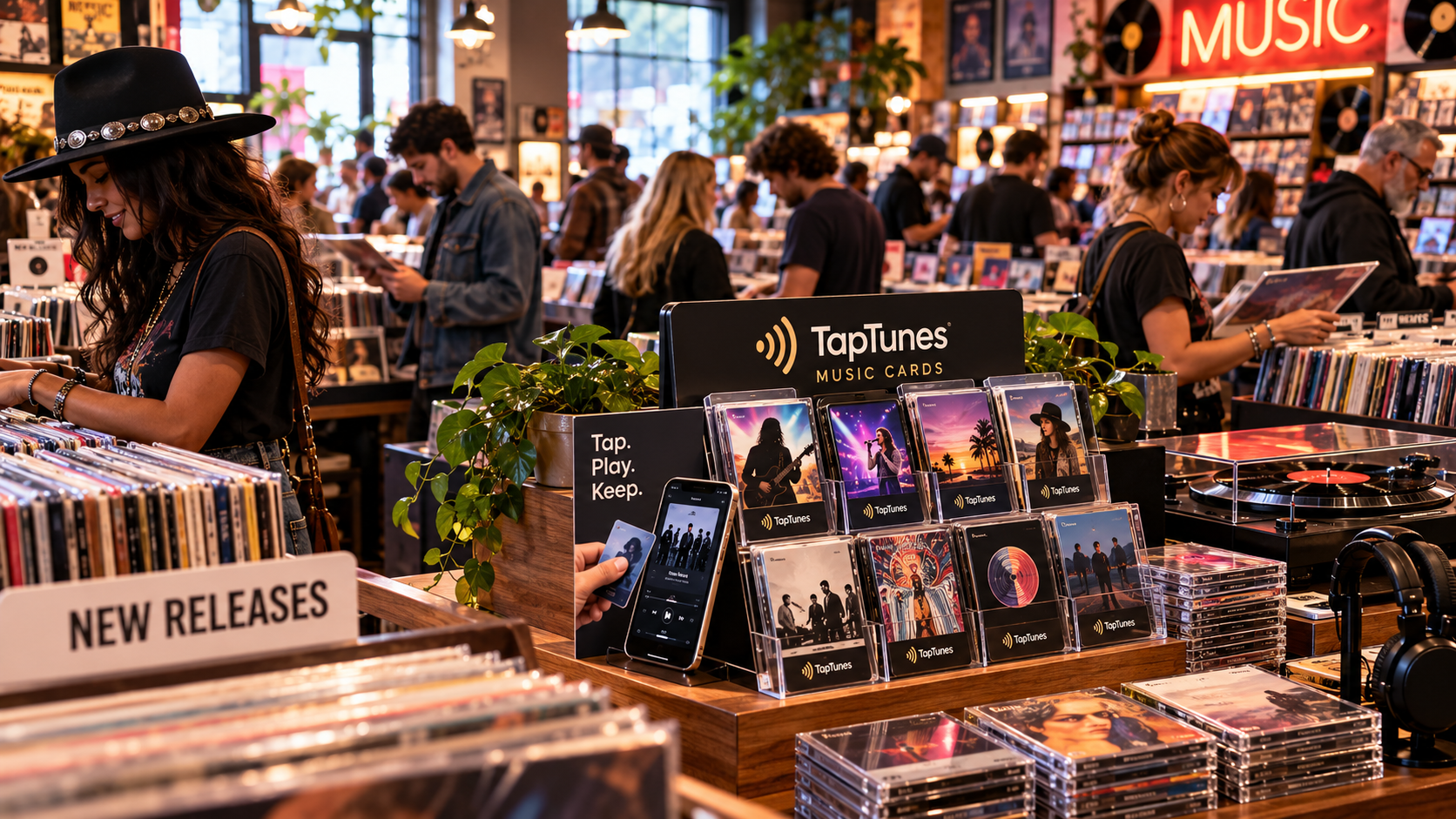
For years, the story of physical music was largely the story of vinyl.
Records returned. Pressing plants expanded. Record Store Day became an annual event. Limited editions, colored vinyl and deluxe packages gave collectors reasons to buy music they could already stream instantly.
But in 2026, something broader is happening.
Physical music is growing again across multiple formats, and some of the most surprising movement is coming from the compact disc.
According to U.S. recorded music data for the first half of 2026, physical music revenue increased sharply compared with the same period a year earlier. Vinyl continued its long-running resurgence, while CDs recorded one of their strongest recent periods of growth.
The numbers suggest that the physical music story may be entering a new chapter.
Vinyl Keeps Moving Forward
Vinyl remains the heavyweight of the U.S. physical music market.
During the first half of 2026, U.S. vinyl revenue increased 17.7 percent year over year, reaching approximately $554 million.
That follows another strong year globally. In 2025, vinyl revenue increased 13.7 percent worldwide, marking its 19th consecutive year of growth.
What once looked like a nostalgia-driven revival has become an established part of the music business.
Vinyl has also evolved beyond being simply another way to play an album. Artwork, colored pressings, alternate covers, signed editions and limited releases have turned records into collectible extensions of an artist and release.
For many fans, owning the record matters even when streaming remains their primary way of listening.
The Bigger Surprise Is CD
The CD may be becoming interesting again.
U.S. CD purchases reached roughly 16 million units during the first half of 2026 according to Luminate, representing double-digit growth compared with the previous year.
RIAA revenue figures tell an equally striking story. CD revenue increased nearly 59 percent during the first half of 2026 compared with the same period in 2025.
The reasons go beyond nostalgia.
CDs are relatively inexpensive, easy to manufacture and increasingly being treated as collectibles. K-pop has played an important role in the format's renewed popularity, but the trend is not limited to K-pop.
Luminate reported that even after removing K-pop-specific data, U.S. CD sales still increased 6.7 percent.
Perhaps the most revealing statistic is this: roughly half of Gen Z and millennial CD buyers do not even own a CD player.
That changes the conversation entirely.
If consumers are purchasing CDs without having the equipment required to play them, then the physical object itself has become part of the value.
Physical Music Is Becoming a Representation of Fandom
That may be the most important shift taking place.
Streaming solved access.
Fans can hear almost anything, almost anywhere, immediately. But unlimited access also made music less tangible.
Physical products offer something streaming cannot: an object connected to the artist, album, tour, moment or community surrounding the music.
Globally, physical recorded music revenue reached approximately $5.3 billion in 2025, increasing 8 percent from the previous year. Physical formats actually grew at a faster percentage rate than streaming revenue during the year, although streaming remains overwhelmingly larger.
The market is not moving backward.
It is showing that convenience and ownership can exist at the same time.
The Definition of Physical Music Is Expanding
Vinyl and CDs are also no longer the entire physical music conversation.
Cassettes, deluxe packages, box sets, collectible editions and other products continue to occupy smaller but meaningful corners of the market.
And now technology is creating another category.
Beginning October 2, Luminate will begin tracking Smart Media Albums in the United States and Canada alongside CDs, vinyl, cassettes, DVDs and other physical formats.
Smart Media Albums combine a physical product with digital music access, typically using technologies such as NFC or QR to connect the object to an online music experience.
It represents an important evolution of an idea the music industry has relied upon for decades: give the fan something worth owning.
The technology is different. The underlying behavior is not.
The Physical Product Has a New Job
For much of music history, the physical product was necessary because it carried the music.
Today, it does not have to.
Streaming already handles distribution remarkably well.
That frees the physical product to serve a different purpose.
It can become the collectible, the souvenir, the signed piece from the show, the limited edition, the VIP item, the direct connection to an artist or the gateway into a larger digital experience.
That may explain why physical music continues to find new life despite living in a streaming-dominated world.
Fans are not necessarily choosing between physical and digital anymore.
They are using them differently.
Streaming provides access.
Physical music provides something to keep.
And in 2026, more fans appear to want both.
Sources & Supporting Data
RIAA: First-half 2026 U.S. vinyl revenue increased 17.7%, while CD revenue increased 58.6% compared with the same period in 2025.
Source: RIAA 2026 Mid-Year Recorded Music Revenue Report
Luminate: U.S. consumers purchased approximately 16.3 million CDs during the first half of 2026, an increase of 16%. Even when K-pop releases were excluded, CD sales still increased 6.7%.
Source: Luminate, U.S. Midyear Music Report / Smart Media Album reporting
https://luminatedata.com/blog/luminate-to-track-smart-media-album-sales-in-connect/
IFPI: Global physical recorded music revenue reached approximately $5.3 billion in 2025, an increase of 8%. Vinyl revenue grew 13.7%, marking the format's 19th consecutive year of growth.
Source: IFPI Global Music Report 2026
https://www.ifpi.org/wp-content/uploads/2026/03/GMR2026_SOTI.pdf