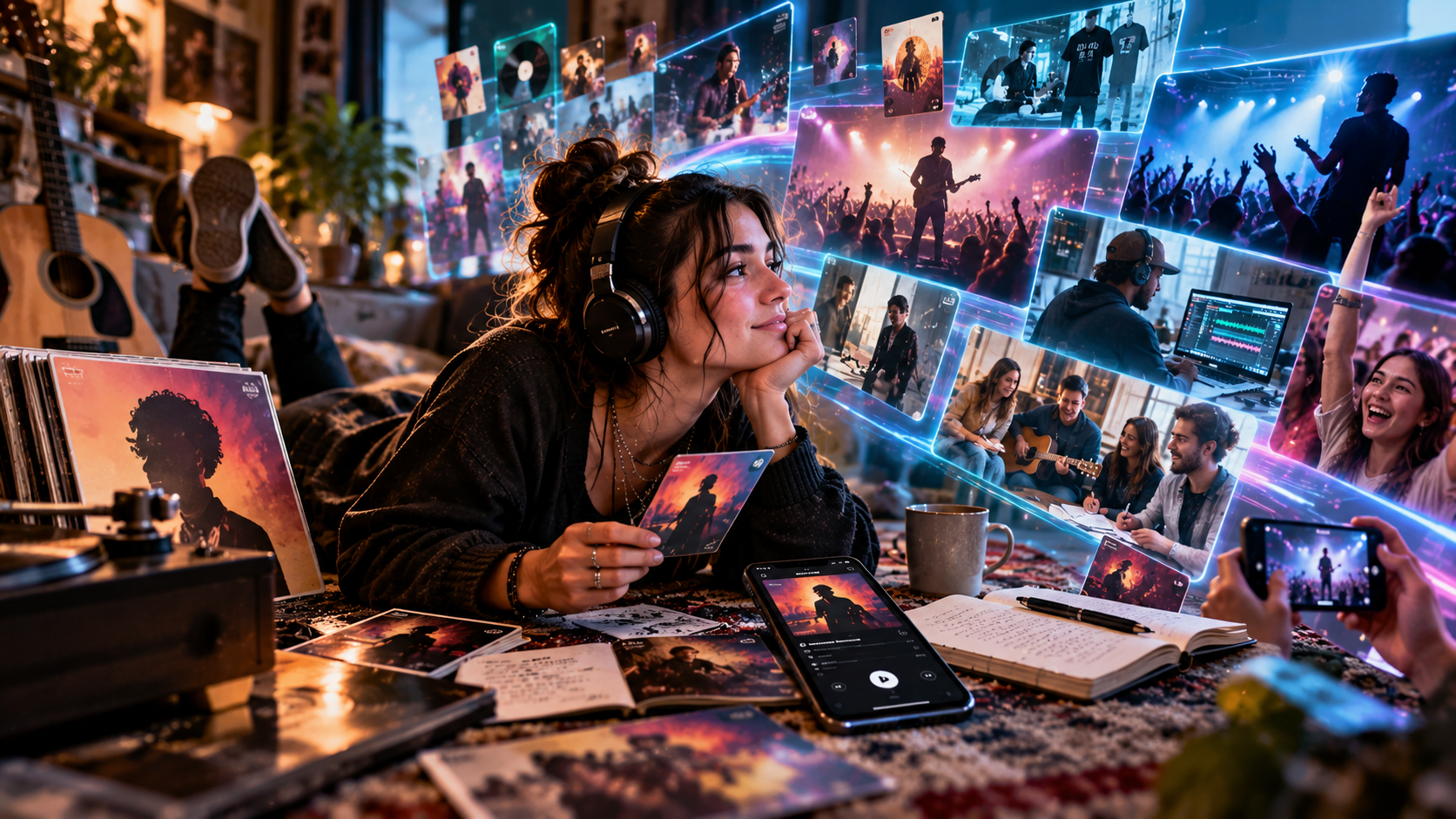
For most of recorded music history, the relationship was straightforward: artists created music and fans listened.
That relationship is beginning to change.
The next evolution of the music business may not be defined by another format replacing streaming. Instead, it may be defined by something much bigger: fans moving from listeners to participants.
Across the industry, pieces of that future are already appearing. Fans are gaining new ways to interact with releases, access artist communities, unlock experiences, remix music, collect physical products and participate in the worlds artists build around their music.
The future may be less about where a song lives and more about what happens around it.
From Consumption to Participation
Streaming transformed music into nearly unlimited access. The next phase appears to be adding interaction to that access.
Spotify has already described its strategy as moving beyond curation and recommendation toward more personalized and interactive media. The company has also announced licensed tools allowing fans to create covers and remixes from participating artist and songwriter catalogs, with consent, credit and compensation built into the system.
That represents an important change.
A fan may no longer simply press play. They could interact with the music, participate in an artist's community, gain access to experiences or create something within boundaries established by the artist.
Music becomes the beginning of the experience rather than the end of it.
The Album Could Become a Living Environment
Albums have traditionally been finished products. Once released, the track list, artwork and packaging were largely fixed.
Connected technology changes that.
Digital platforms and connected physical products can allow an album experience to continue developing after release. Artists could add bonus material, behind-the-scenes content, live performances, messages, videos, alternate versions or experiences long after the original purchase.
That means tomorrow's album may not necessarily be something fans experience once and place on a shelf.
It could become a place they return to.
The emergence of Smart Media Albums is one example of that shift. Physical products can now connect directly to digital environments while retaining the ownership and collectibility fans associate with physical music.
Fandom Could Become Continuous
The traditional music business revolves around release cycles: announce the single, release the album, tour it and eventually begin again.
Fans don't necessarily experience artists that way.
Recent media research points toward what could become a much larger idea: continuous fandom.
Instead of communicating with fans primarily around releases, artists could maintain an ongoing environment connecting music, community, merchandise, live experiences, exclusive content and communication.
That changes the economics of a fan relationship as well.
The industry has traditionally measured individual transactions: an album sale, stream, ticket or piece of merchandise. A more connected music economy may increasingly look at the relationship across years.
A fan who discovers an artist today could potentially buy music, attend concerts, collect releases and participate in that artist's community for decades.
The valuable asset isn't simply the transaction.
It's the relationship.
AI Could Make Human Identity More Important
Artificial intelligence will undoubtedly play a role in this future, but perhaps not exactly as many expected.
As generating music becomes easier, knowing who created something may become more important.
Platforms are already beginning to introduce greater transparency around AI-generated music and artist identities. Qobuz recently introduced labels identifying AI-generated music, while other platforms are developing additional artist identity and AI disclosure systems.
That could create an interesting reversal.
For years, technology made music increasingly frictionless and anonymous. In an environment where almost anything can be generated, authenticity, provenance and artist identity may become valuable differentiators.
The artist's name, story, community and relationship with fans could matter more precisely because music itself becomes easier to manufacture.
The Fan May Become Part of the Creative Economy
One of the more interesting possibilities is licensed fan creation.
Fans already make remixes, videos, memes, covers and other creations around the artists they love. Emerging technology could turn some of that behavior into a legitimate part of the music economy.
With permission and clearly defined boundaries, fans could potentially create authorized remixes, alternate versions or personalized experiences connected to an artist's work.
That raises complicated questions about copyright, identity, compensation and control. But it also creates an entirely new possibility.
Instead of treating every fan-created interaction as something happening outside the official music business, artists and rights holders could create environments where participation is encouraged, credited and potentially monetized.
Music May Be Moving Beyond the Play Button
None of this means people will stop streaming songs, buying vinyl or attending concerts.
Those behaviors aren't disappearing.
What may change is everything surrounding them.
A stream could lead to a community. A concert could unlock something that continues afterward. A physical album could connect to an evolving digital experience. A fan could move from listening to participating. And an artist could build a relationship that continues between releases instead of starting over with every new campaign.
The music industry spent decades improving distribution.
Then it spent years improving discovery.
The next major challenge may be something entirely different:
How do we turn access into participation and participation into lasting connection?
If that happens, the future of music won't simply be about how we listen.
It will be about how deeply we become part of the music we love.