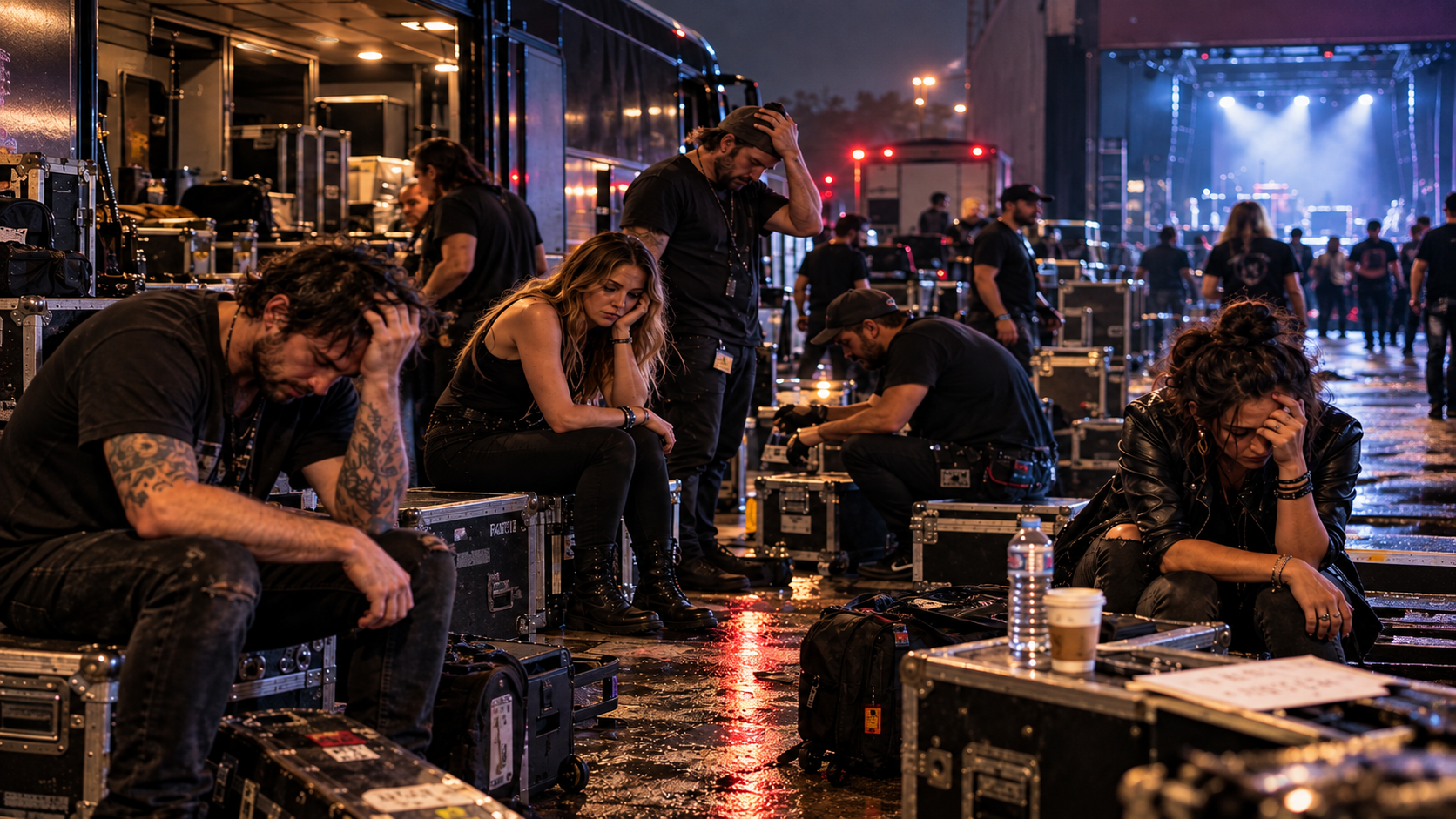
The audience sees the finished product.
The lights go down, the stage comes alive and an artist walks out to a room waiting to hear the music. For the next hour or two, touring can look like one of the greatest jobs in the world.
What the audience rarely sees is the day that happened before the show, or what happens after everyone goes home.
For many working artists, touring is a demanding cycle of highways, airports, hotels, load-ins, soundchecks, performances and late-night departures. The show might last 90 minutes, but the working day surrounding it can stretch far beyond that. Add delayed flights, vehicle problems, equipment failures, weather, illness and last-minute changes, and simply getting a show onto the stage can become an accomplishment of its own.
There is also an entire operation behind every performance. Tour managers, musicians, drivers, sound engineers, lighting technicians, production crews, merchandise sellers, promoters and venue staff are responsible for making something complicated appear effortless. When they do their jobs well, the audience may never realize there was a problem at all.
Not Every Night Looks Like Social Media
Touring also carries financial uncertainty that isn't obvious from photographs and performance clips. A crowded section of a venue can make a show appear successful without revealing what ticket sales looked like across the entire room, how much it cost to get there or whether the artist actually made money.
Transportation, lodging, fuel, musicians, crew, production, food and merchandise expenses continue regardless of how many people walk through the door. An artist can travel hundreds of miles to play a market only to discover that advance sales did not develop as expected. The show still happens, the people who came still deserve a performance, and the expenses still have to be paid.
For independent and developing artists, that reality can make touring particularly difficult. The road often requires significant spending before the first ticket or T-shirt is sold, and even a tour that appears successful from the outside may produce surprisingly thin margins once the bills are paid.
Then there are the disappointments that cannot easily be measured on a spreadsheet. A poorly attended show after a strong night. A promising opportunity that disappears. A venue that does not promote the date as expected. A market that worked last year but doesn't this year. Artists have to absorb those moments quickly because another city is already waiting.
The Human Side of the Road
Touring also means temporarily stepping away from normal life. Birthdays, anniversaries and family events are missed. Relationships are maintained from hotel rooms and highways. Sleep schedules change constantly, personal space becomes limited and people who spend their careers surrounded by others can still experience considerable isolation.
There is a peculiar emotional contrast built into performing. An artist can spend the evening standing under lights while hundreds or thousands of people applaud and, a short time later, be alone in a hotel room preparing to leave for another city the following morning.
The industry has increasingly begun acknowledging the physical and emotional demands placed on artists and touring professionals. That conversation is important because touring isn't simply a collection of performances. For weeks or months at a time, it becomes a way of life.
And the artist is only one person living it. The musicians and crew travel the same miles, endure many of the same long days and repeatedly solve problems the audience never knows occurred. The seamless show people experience from their seats is often the result of considerable work happening where they cannot see it.
Why the Road Still Matters
Despite the costs, uncertainty and exhaustion, artists continue going on the road because live music provides something difficult to reproduce anywhere else.
A song written privately, recorded in a studio and distributed digitally suddenly exists in a room full of people. Listeners become faces. Streaming numbers become an audience. Fans who may have interacted with an artist only through a screen are standing a few feet away singing the words back.
That connection remains one of the most powerful parts of making music.
But understanding touring means understanding both sides of it.
There is the show the audience sees, and there is everything required to make that show happen: the miles traveled, the money risked, the family moments missed, the disappointing nights, the exhaustion, the crew working behind the curtain and the decision to wake up the next morning and move on to another city.
The stage lights reveal only part of the story.
The rest happens on the road.